Telling Our Own Story to Avoid Being Told by Others
Ways of Europe arrives in Barcelona to reflect on the integration of the Roma community in Europe
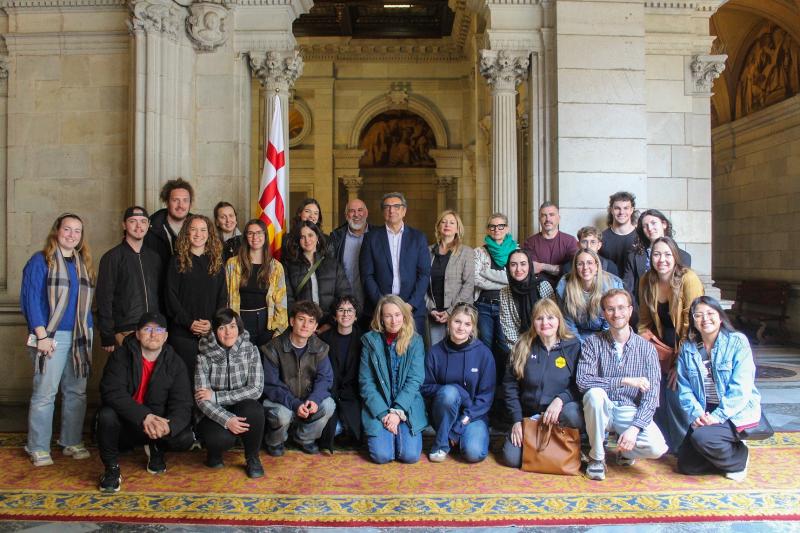
The fourth transnational conference takes place with the new year in vibrant and multifaceted Barcelona, with Fundació Privada Pere Closa as its central protagonist. Over three days, the foundation proudly and passionately presents its long-standing activism for the integration of the Roma community in Catalonia.
Rambla de la Mina 2. A reality that speaks for itself: the Rambla, Barcelona’s most famous avenue, and La Mina, the neighborhood at its margins that the city would rather forget. On March 17, the first day of the conference, Vincente Rodriguez’s presentation on the history of the community shows how living, studying, and narrating these experiences is a complex and often controversial process. Did you know that the Roma community most likely originated in India? That Romani is an Indo-European language like Latin? That the first documented presence of Roma people in the Iberian Peninsula dates back to 1425 in Zaragoza, based on the safe-conduct granted by King Alfonso V of Aragon?
From dance to Django Reinhardt, many symbols that have been naturalized as Spanish are not originally so, but are the result of a silent and ongoing cultural appropriation that only knowledge can clarify.
In the early afternoon, a tour of the Barrio de la Mina is accompanied by the life story of a local witness. The neighborhood was created during Francisco Franco’s dictatorship, conceived as an urban space to conceal the Roma community. The old overcrowded buildings lacked running water and electricity, and the available transport did not allow real connection between the city center and the neighborhood. Franco fell, but the isolation of the area did not end with him. The construction of a highway and the presence of a river on the opposite side have further isolated it, while few seem to care about the quality of life there. “What is this street called?” I ask. “Calle Venus,” comes the reply. Here, streets are named after the solar system—“they chose the most distant and difficult world they could imagine,” someone adds. The school, the foundation, and the sports fields become spaces of resistance against both exclusion and superficial integration, which newly built luxury apartments—facing the sea, yet too hesitant to overlook the realities of La Mina—attempt to conceal.
On March 18, the meeting moves to the Museu d’Història de Catalunya for a temporary exhibition titled “The Roma Community of Catalonia.” The guide is historian Mercedes Porras Soto, curator of the exhibition, who explains what it means to be Roma and to carry this past. From oral tradition to street photography, the exhibition illustrates the construction of a community identity that has crossed centuries and geographical boundaries, and is still proudly upheld today. Giving voice to individuals, to particular experiences, and to what remains hidden confirms itself as the first step in resisting a flattening and depersonalizing indifference.
The rejection of paternalistic attitudes and trend-driven activism is also at the core of this fourth Manifesto. In the afternoon, round tables allowed for the drafting and detailed discussion of its objectives: promoting policies of active presence in local contexts, fostering a deconstructed education that values critical approaches to information—these are shared priorities. Committing to being the voice of civil society in its most diverse expressions, and fighting against urban, economic, and professional exclusion, remains for Ways of Europe a pledge of faith to restore belief in Europe and its value among those who had been left behind.
On the final day, March 19, Pere Closa brings the Manifesto to the table of the Ajuntament de Barcelona. The project is thus incorporated into the city’s anti-racist policies, which are set to be implemented through a ten-year plan. The normalization of inequalities has long lulled society into complacency, and the inertia of civil society has benefited only the most cynical advocates of a polarized and unaccountable world. We want change—do you?
Photogallery