Same journey, next chapter
Almost two years ago, Ways of Europe set off from Brussels. In October we came back, carrying everything the road had given us.
When we left, in November 2024, the idea was simple and ambitious: to go and look for Europe where it is rarely looked for. On its borders, physical and otherwise. In the places where rights are tested every day, and among the people who are almost never asked what Europe means to them.
The road took us to Lampedusa, where solidarity is a daily practice long before it becomes a word in a policy paper. Then to Calais and Dunkerque, between camps and coastlines, and to Budapest, where talking about the rule of law is anything but abstract. It took us to Barcelona, and to the long fight against discrimination faced by Roma communities. Then to Turin, where a citizens' assembly turned conversations into recommendations, and to Rome, where everything we had gathered became a campaign.
Everywhere we went we found walls: rights denied, or not yet reached. And everywhere, in front of those walls, someone had built a door. A network of volunteers, a workshop at school, a song, a neighbourhood that refused to look away.
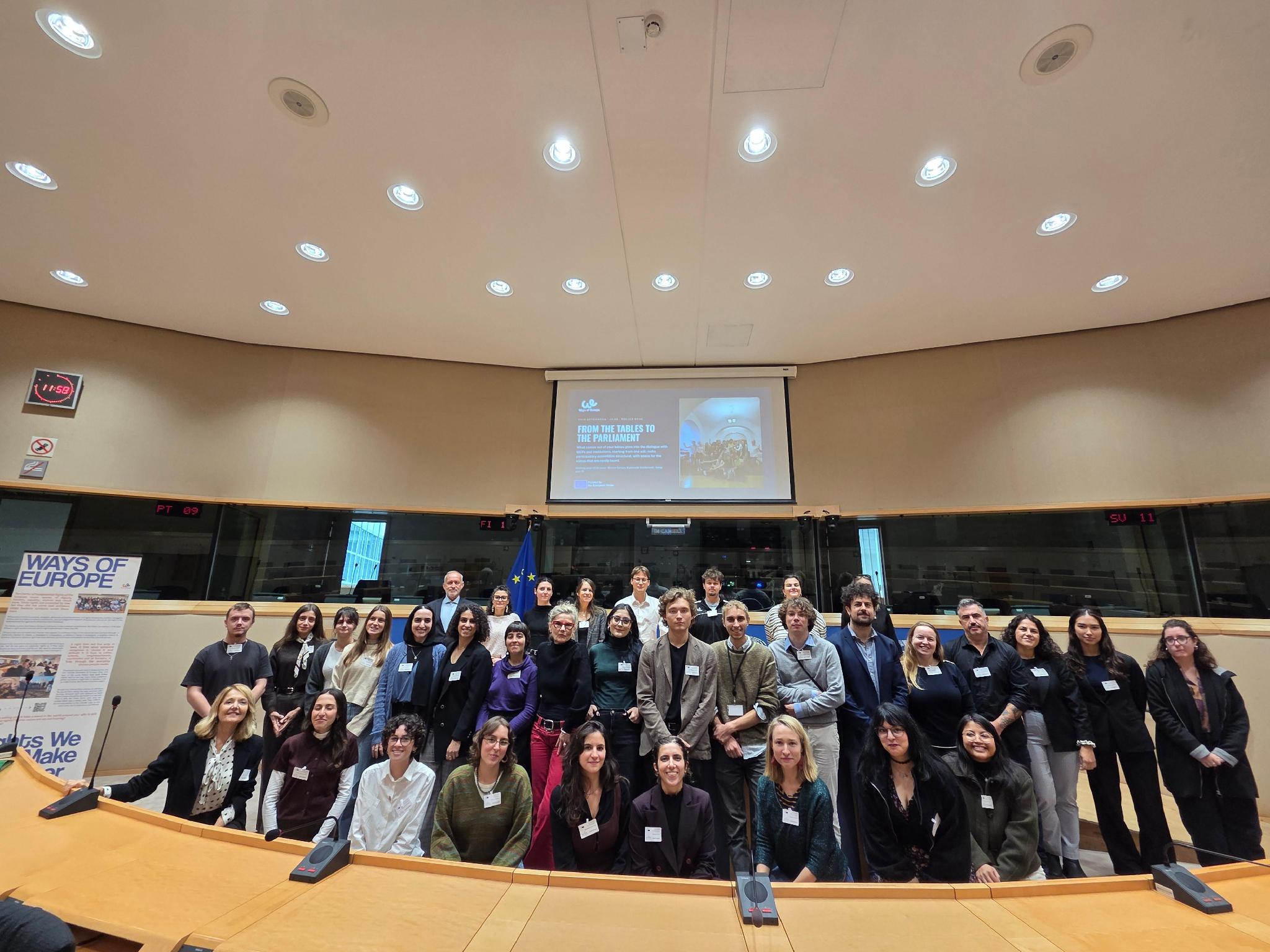
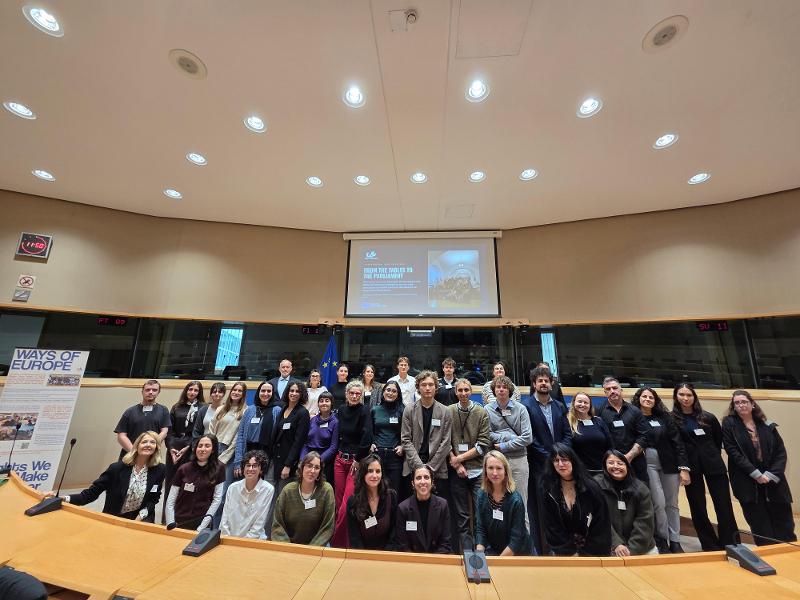
On 12 October 2026 we brought those walls and doors back to Brussels, where more than 50 people from seven countries met for three days.
The first afternoon, at the European Youth Forum, felt like opening a suitcase after a long trip. Each partner took out one thing Brussels needed to hear, and one lesson about reaching people who are rarely listened to. Someone said that "the margin is actually the centre", because what happens at the edges reveals contradictions that concern all of us, and any of us might end up there one day. Someone else reminded us that "Europe also belongs to the neighbourhoods". The partners split into five teams, one for each stop of the journey, and prepared the five tables where the next morning they would welcome organisations from across Europe. Each team went back to its own manifesto and creative work, and adapted the questions to its place: what still resonates, what needs updating, what is still missing from the European debate.
On Tuesday morning, in a room of the European Parliament, those tables came to life. People talked about dignity at the heart of migration policies, with migrants taking part in the debate. Participation needs conditions: a home, legal status, economic security. Civil society, in turn, needs protected civic space and independent funding to do its work. Fighting discrimination means changing structures, starting from schools and from recognising Roma history in what children learn. And at the Calais and Dunkerque table, a young participant said that, without this project, he would probably never have met a migrant in person, and that seeing how people live there had changed the way he understands migration.
In the afternoon the same stories moved to another building of the Parliament, for the Institutional Exchange hosted by MEP Dario Tamburrano. After the screening of WAYS, the video made in Calais and Dunkerque, we told the journey stop by stop, wall by wall, door by door. Then we listened, and we asked. MEP Benedetta Scuderi, Bologna City Councillor Anna Lisa Boni and MEP Brando Benifei each answered a question born in one of the places we had visited, and the room joined in. Our request was one: citizens' assemblies that are structural rather than occasional, that give a motivated answer to every proposal, and that are open to the voices that are still not heard.
Later, in the video of the WE ambassadors, Khaled put it in the simplest words: "Don't just talk about us, talk to us."
Around us, the whole journey was there to be touched: the roll-ups of the Ways of Europe exhibition, the manifestos, and Walls & Doors, the game that turns the journey into an experience to play together.
On the last morning, back at the Youth Forum, we did what you do at the end of every journey. We looked back, counted what we had gained, and started talking about the next one: how to keep the ambassadors and the network connected once the project is over.
What we take home from Brussels is something many participants felt when meeting organisations from other countries working on the same themes: no one is alone, because local needs are shared at European level. Perhaps this is the real result of these two years: a network of people and organisations who know what to ask for. Not just more chances to speak, but the certainty that what people say will have consequences.
Nothing is written in stone. Rights are made by people, in their struggles and in the contradictions they bring to light. Every time someone points out where a right fails, or builds a way to make it work, the story of Europe keeps being written.
Ways of Europe ends here. The journey doesn't.
Photogallery