Care, Participation and Female Leadership: Stories from Ways of Europe in Hungary
The experiences of Tamara Jara Soto and Nikolett Gábri show how everyday actions within local communities can turn European values into concrete practices of inclusion, dialogue and social change
For centuries it was believed — or, rather, it was convenient to believe — that women were naturally inclined to care for others, driven by some innate maternal instinct supposedly extended to all humankind. Yet the response to this unhealthy paradigm, which generation after generation confined our foremothers within the walls of the domestic sphere, cannot possibly be indifference toward others.
Care, in fact, can be a powerful weapon — perhaps the most formidable one — when it is the result of a conscious choice and exercised with awareness. A tangible example of this perspective can be found in the experience of the Hungarian activists involved in Ways of Europe.
For Tamara Jara Soto, who arrived in Budapest from Chile to pursue her studies, encountering the Subjective Values Foundation first answered a personal need: to find a way to feel part of the city and contribute concretely to the community in which she was living.
Having joined the foundation about a year ago, Tamara discovered a team where collaborators and trainees — mostly women — work side by side every day to promote cultural diversity, social inclusion and active citizenship. Under the guidance of project manager Tuqa Kamal, the foundation advances through cooperation, empathy and solid organizational skills, taking shape through direct engagement with young women, migrants and people at risk of social exclusion.
For Tamara, what makes these experiences meaningful is their human dimension: the ability to create spaces where people can meet, tell their stories and feel heard. This conviction drives the foundation’s work: the belief that participation grows out of authentic relationships and that, by translating European ideals into concrete experiences, female leadership can inspire lasting social change.
One’s own community can become the stage on which practices of solidarity and mutual support take shape. Yet for some, that stage is literal — made of wooden beams and iron nails. For Nikolett Gábri, theatre has long been a place of personal transformation, a space to experiment with new perspectives.
Today that experience informs her work with the Faktor Terminal Association, where she uses applied arts — particularly theatre-based methods — to support the personal development of young women. Together with artistic director Marta Schermann, Nikolett has led workshops with girls in challenging contexts, such as the Rákospalota Juvenile Detention Centre and the Special Children’s Home in Esztergom.
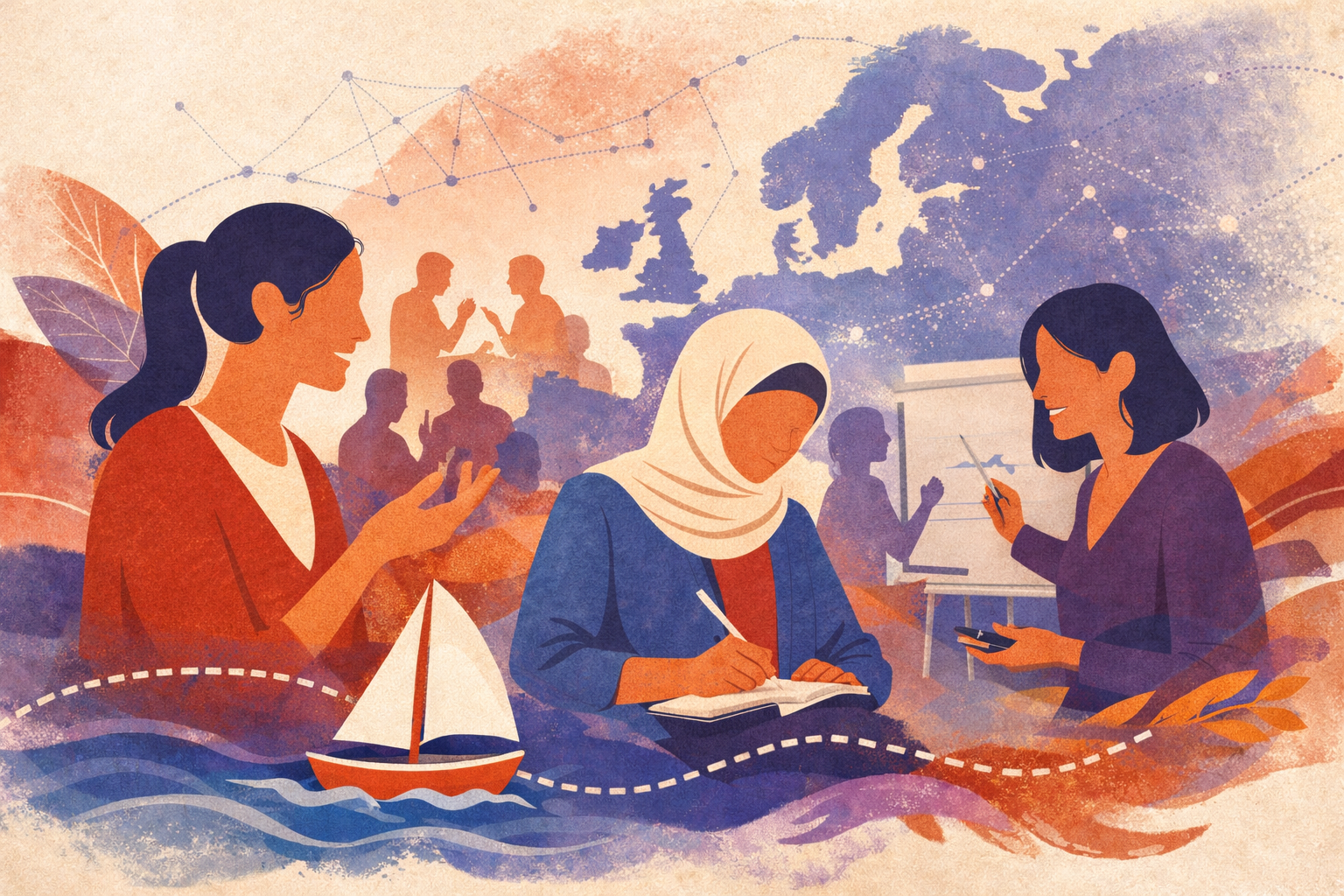
At the heart of these meetings are creative exercises designed to help participants imagine and narrate their own futures. In one of the most intense activities, the girls were invited to picture themselves as boats on a journey, reflecting on their direction, their emotions and the possibility of choosing their own course. After this reflective phase, they expressed their experiences through drawings or discussion, sharing deeply personal images of their imagined futures.
For Nikolett, moments like these are powerful reminders of how essential it is to create spaces where young women can give voice to hopes, fears and possibilities for their lives. Through reflection and sharing, the performing arts become a genuine tool of empowerment, capable of strengthening both self-esteem and self-awareness.
European solidarity does not originate from above, within institutions, but operates quietly every day. Dozens, hundreds of women like Tamara and Nikolett care for their communities on a daily basis: many have transformed their passions into collective action, creating spaces of listening and support for those at risk of being left on the margins. It is a form of care that is not imposed but chosen consciously — one that shows how helping others is not a natural instinct, but the result of cooperation, perseverance and empathy, and above all of conviction and passion.
Photogallery